
Your Christmas centerpiece at a glance:
- Centerpiece, not wreath: a Christmas centerpiece stands in soaked floral foam, a wreath sits dry on its base
- An Advent centerpiece is the same piece of work: same construction, just with four candles for the four Sundays
- Five shapes: flat, bowl, standing, elongated, small, each built for a different sightline
- Elongated for the long table: the narrow runner keeps the view across the whole table clear
- The greenery decides: noble fir, cedar, eucalyptus, holly and cones behave very differently in a warm room, and they carry the style at the same time, classic, modern or Nordic
- Candles need room: real light needs air around the greenery, in offices and hospitality LED usually takes over
It is just after five on a November evening, and the workshop lights have been on for an hour. A brick of floral foam lies in a shallow tray drawing water, very slowly, until it sinks of its own accord. Noble fir is stacked beside it, and the resinous scent hangs so thickly in the room that you carry it home in your coat. A cedar branch cracks quietly as we break it to length. Our hands are cold from the wet foam, and this is the exact moment that decides whether this Christmas centerpiece will last until Christmas Eve.

Almost anything green standing on a table in December gets called an Advent wreath in everyday speech. The difference, though, is not in the look but underneath the greenery. A Christmas centerpiece stands in soaked floral foam and keeps drinking for as long as it stands. We have been setting and binding in Berlin and on Mallorca for over 25 years, and in our work this one difference is the reason why one piece stays fresh in a warm living room while another sheds after a few days.
We will show you the five shapes and what each one is built for, which greenery actually works in a Christmas centerpiece, which flower makes the difference, how a candle sits safely and how you recognise classic, modern and Nordic. By the end you will know which piece belongs on your dining table and which one belongs on a reception desk. Let yourself be inspired.
Christmas centerpiece, Advent centerpiece, Advent wreath: where the difference lies
Two pieces stand side by side on the table, and at first glance they are siblings. Both carry noble fir, both carry cones, both carry candles. Turn them over and the resemblance ends immediately. Under one lies a ring of pressed straw, under the other a block heavy with water.

The base decides, not the shape
An Advent wreath is a closed ring. Its greenery is bound onto a straw base or a wire frame, layer by layer, and from that moment on it receives no more water. It lives on the moisture held in the branches, and on nothing else.
A centerpiece, by contrast, is set rather than bound. Every branch and every stem goes into a block that has taken up water beforehand, and draws from it for as long as it stands. Almost everything else follows from that. The shape is free, because no ring dictates it. The mixture can be softer, because flowers are supplied too. And the location becomes a decision, because water disappears faster by a radiator than at a cool window.
When each word fits
Four terms get tangled in everyday use, and even search engines throw them together. The distinction is simpler than it sounds. It runs through the base and the occasion, not through the look:
| Term | Base | What it carries | What it is built for |
|---|---|---|---|
| Christmas centerpiece | soaked floral foam in a bowl, on a plate or on a wood slice | greenery, flowers, cones, candles | freely chosen shape, stays in one place |
| Advent centerpiece | soaked floral foam, usually elongated or round | traditionally four candles, one per Advent Sunday | the four Advent Sundays at the table |
| Advent wreath | straw base or a frame of wire and wood, no water | greenery and traditionally four candles | hangs or lies, a closed ring |
| Table arrangement | shallow floral foam in a bowl or on a tray | low greenery, a flower, a tealight | an occupied table, the sightline stays clear |
So an Advent centerpiece is nothing other than a Christmas centerpiece with an Advent brief, and anyone speaking of an arrangement for Christmas means the same piece of work without the four candles. A table arrangement is a building constraint, not a category of its own. Arrangements for cemeteries and graves follow their own rules and stay out of scope here.
Once you know the base, every further decision almost makes itself.
The five shapes and what they are built for
Five finished pieces stand in a row on the workshop table, and the height grows from left to right. The flat one lies almost on the surface, the last one reaches eye level. Nobody thought about beauty first while building them, but about who would be standing in front of them later.

The five shapes through a workshop lens
The flat arrangement – low on a plate or wood slice. It spreads outwards instead of reaching upwards and is almost always read from above. The floral foam disappears completely under greenery, otherwise the construction gives itself away at the edge. On a sideboard this shape feels calm, as though the greenery had simply come to rest there.
The bowl arrangement – round and with no front. Set into a shallow bowl and worked evenly from every side, it has no back. That is exactly what makes it the piece for round tables where everyone sits facing each other. A bowl forgives little, because every gap is visible from some position.
The standing arrangement – height from branches, not from foam. Here the piece grows upwards, and the art lies in keeping the centre of gravity low. We build the height with long, light branches and keep the base broad. On a console or beside an entrance a silhouette emerges that changes the room. This shape has no business in front of seated guests.
The elongated arrangement – the narrow runner for long tables and counters. It stretches across the table as a band, stays low and keeps the sightline clear. Building an elongated Advent centerpiece is above all about holding a rhythm, letting height and depth alternate. On a long table the runner connects every seat, on a reception desk it leads the eye down the length of the room.
The small arrangement – in a glass, on a windowsill, at each place setting. A small Christmas centerpiece is read from close up, and that is why every detail counts. Few materials, clean edges, a single flower or a single cone as the focal point. In a glass the damp foam stays hidden, and the shape survives being carried.
Which shape belongs in which place
Before every commission we work through the same four questions in the workshop:
| Shape | Sightline | Typical place | What matters when building |
|---|---|---|---|
| Flat on a plate or wood slice | from above | sideboard, coffee table, windowsill | low build, foam fully covered, clean edge |
| Bowl, round | from every side | round table, side table | no front, set evenly from each side |
| Standing | from the front and side | console, alcove, entrance | keep the centre of gravity low, height through branches rather than foam |
| Elongated, narrow runner | across the table | long table, reception desk, conference table | stay low, keep the sightline clear, structure the length rhythmically |
| Small, in a glass or on a coaster | from close up | side table, windowsill, place setting | few materials, every detail is read from a short distance |

One rule applies to all five rows. At an occupied table a Christmas centerpiece stays clearly below the eye level of everyone seated, or it reaches so far above it that the view passes comfortably underneath. Anything in between forces your guests to lean aside.
The shape is not a matter of taste, it follows from who stands in front of it and who sits in front of it.
Christmas centerpiece or Advent wreath: which lasts longer?
As a rule the Christmas centerpiece stays fresh longer, and the reason sits underneath the greenery. It stands in soaked floral foam and draws water for as long as the reservoir holds. An Advent wreath is bound dry and lives only on the moisture inside the branches. The location decides the rest.
There is one small move that reveals who has been doing this longer. The brick of foam goes into the tray and simply lies there, with nobody touching it. It soaks itself full and sinks quietly as it does. Anyone who pushes it under and squeezes forces pockets of air into the block, and that is exactly where water will never reach later.
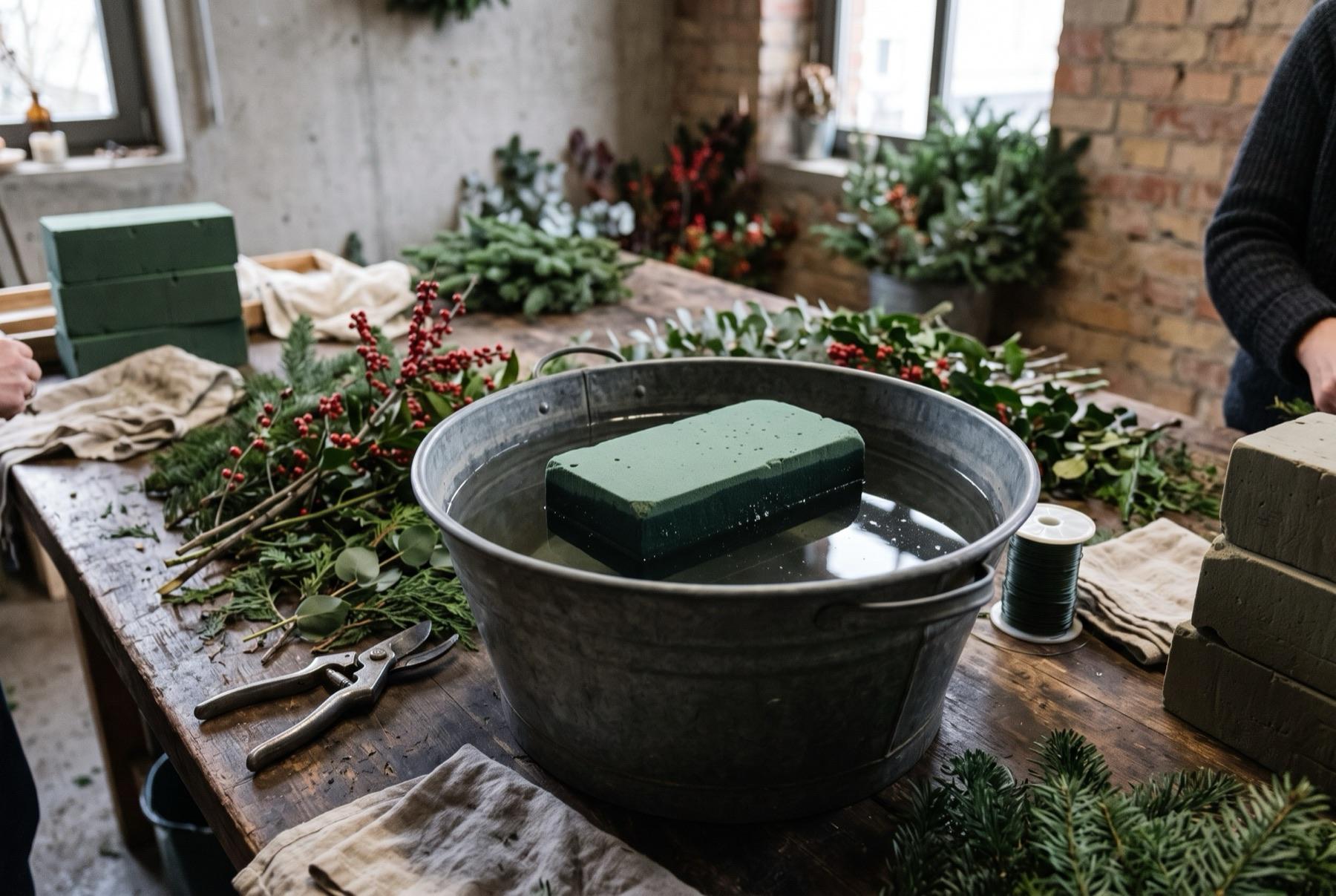
The soaked floral foam nobody talks about
In guides, floral foam almost always appears as a shopping item, right behind wire and hot glue. Yet it is the reason a Christmas centerpiece ages differently from a wreath. Every stem stands in a damp reservoir and keeps drawing as long as it holds water.
That shifts the choice of material. Into a wreath goes only what survives without water. Into a centerpiece goes what needs to drink too, and that opens the door to flowers, soft leaves and branches that would wilt quickly in a dry ring. A centerpiece is not a decorated wreath, it is a small standing flower bed.
Dry heating, draughts, candle warmth
What really tests an arrangement in December is not in the material but in the room. Dry heated air pulls more moisture out of greenery in a few hours than a whole cool day does. A draught beside an entrance door does the same, just less noticeably. And every burning candle warms the air directly above the piece.
So an arrangement belongs away from the radiator, away from the fireplace, and ideally overnight in the coolest spot in your home. Top up at the edge, with a narrow can, directly onto the foam and not over the greenery. Water on needles only evaporates, water at the base does the work.
Insider tip – let the brick float. Lay the floral foam on the surface of the water and wait until it goes under by itself. Then it is evenly saturated. Later, pour at the rim of the bowl until the water sits just above the foam, and rather once too often than too much at once. If the foam sits permanently under water, the cut ends rot.
There is no single number that holds true for every room.
Are you preparing a reception, a conference or a hospitality space for the Christmas season and want floristry that carries through the season? Tell us about your building and your rooms. You can see how we accompany companies through December on Christmas floristry for businesses.
The greenery in a Christmas centerpiece
Pick up five varieties side by side and you notice the difference before you see it. Noble fir is heavy and resinous, cedar falls softly over your fingers, eucalyptus is cool and leathery, holly stiff and prickly. Each variety works differently in a Christmas centerpiece, and that is precisely why we mix them.

Five varieties we set into an arrangement
Noble fir – the backbone. The blue-green, broadly spaced needles give the piece surface and depth, and the resinous scent fills the room as soon as the heating comes on. Noble fir holds its needles exceptionally well and forgives a warm spot more readily than other firs. We set it first.
Cedar – the soft fall. Cedar branches hang slightly over the edge and take the severity out of an arrangement, especially at the rim of a bowl. Their fine shoots fill gaps without faking volume, and let a runner taper off at the ends rather than break off.
Eucalyptus – the cool colour. The silvery grey-green foliage breaks every Christmas red and makes an arrangement instantly more modern. Eucalyptus dries slowly within the piece, keeps its form while doing so and holds its tone. Its scent is fresh rather than resinous.
Holly – the red dot. The berries deliver a colour no bauble can replace, because they are matt and do not reflect. A few branches are enough, too many make an arrangement look dated. The leaves prick, so holly stays away from the edge you pick the piece up by.
Cones – the structure. Cones bring shadow and unrest in the best sense, they catch candlelight and give a flat arrangement relief. Mounted on wire they sink in deeply instead of sitting on top.
Why we mix differently in an arrangement than in a wreath
In a wreath what counts above all is what survives without water. In an arrangement, branches that want to drink can join in, and they may be shorter, because no wire holds them. We cut tighter, set more densely and mix more varieties.
If your team would like to try the technique themselves, the wreath is the better starting point. For that we come to you with our Advent wreath workshop, from 20 people. Our greenery comes from nurseries and wholesalers we have worked with for years.
An arrangement lets greenery contribute that would give up after a few days in a dry ring.
The flower in a Christmas centerpiece
An amaryllis on the workshop table looks robust and is not. The stem is hollow inside, and anyone pushing it into the foam without support kinks it right at the entry point. Flowers in a Christmas centerpiece are therefore always a decision about technique, not only about colour.
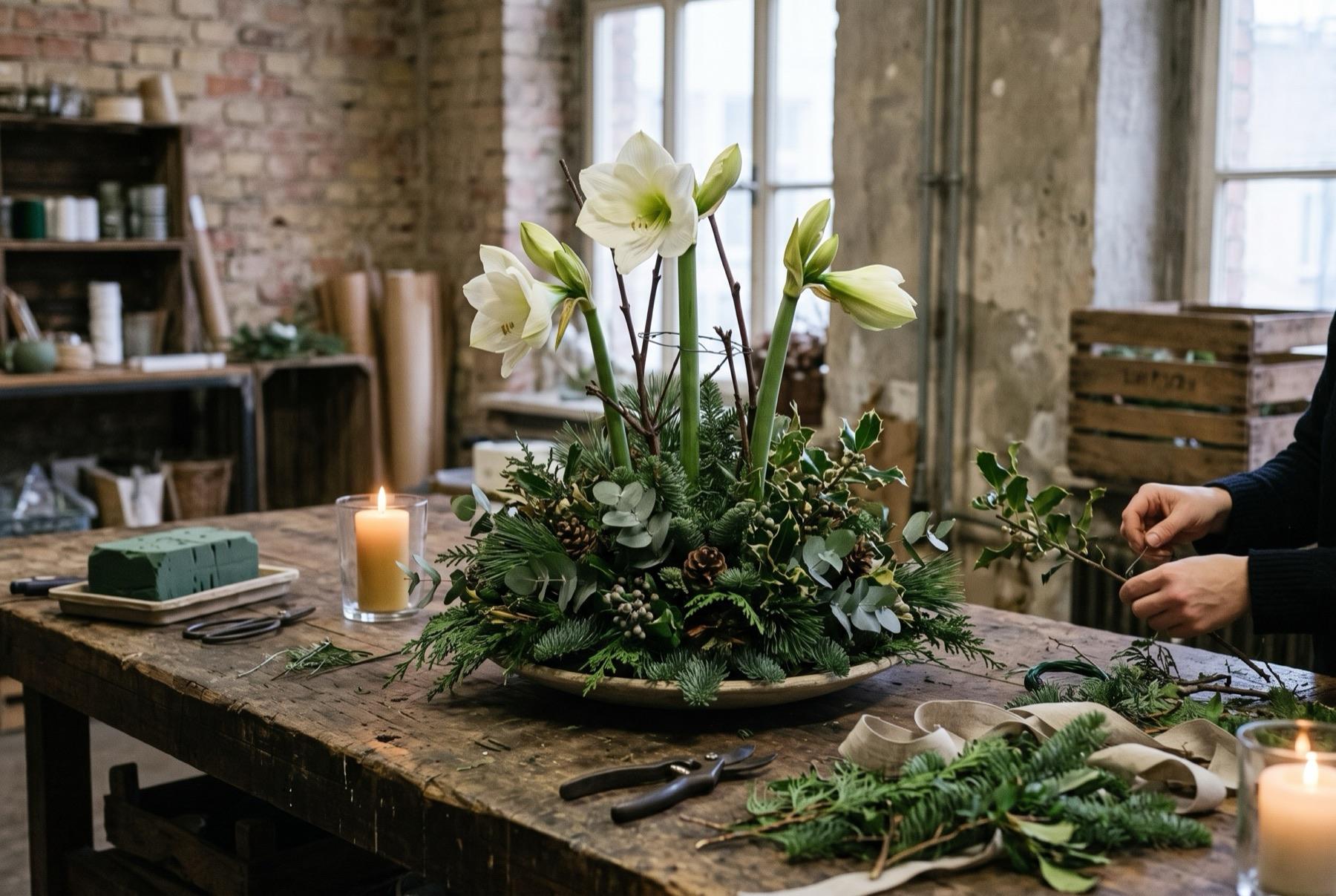
Amaryllis, Christmas rose, ranunculus
Amaryllis – the grand gesture. No other winter flower changes an arrangement so strongly, and a single one is enough. We fill the hollow stem with water and seal it, then a wooden stick supports it from inside. In white it reads as sculptural, in cardinal red as festive and warm.
Christmas rose – the quiet sister. Hellebore tilts its head slightly downwards, as though taking a bow, and brings movement into an otherwise static piece. The stems are soft and need time in water before being set. Christmas rose and Lenten rose both come from this family and can be treated the same way in an arrangement.
Ranunculus – the light source. Its wafer-thin layers catch candlelight like almost nothing else and lift a dark winter arrangement out of the shadows. In cream, pale pink or deep red it suits every one of the three styles. Which winter flowers are at their best and when is shown in our seasonal calendar.
How much flower an arrangement carries
This is where the paths divide. If the flower is to be an accent, it stays a guest among the greenery, set low and concentrated in one spot. If it is to be the focal point, the greenery steps back and becomes a setting, and then two varieties are enough.
What rarely works is the middle ground between the two. An arrangement with many different flowers in equal quantity loses its centre of gravity and looks undecided from a distance.
A single flower changes an arrangement more than any additional bauble.
Candles in a Christmas centerpiece, and what goes wrong
Everyone knows the picture. A candle burned down to the very last stub, scorched greenery underneath, and nobody noticed when it tipped. A Christmas centerpiece with candles is beautiful and it is a responsibility, and in offices and hospitality it is above all a fire safety question.

How the candle sits in the arrangement
Candles do not belong directly in the damp foam but in spike holders or in glass. The holder gives stability and stops the candle drifting sideways in the soft foam. A zone stays clear around the flame where no branch and no dry cone stands.
Almost everyone underestimates draughts. Beside a door or under a vent the flame lies flat and reaches material that seemed far enough away before. A Christmas centerpiece with one candle is therefore often wiser than one with four, because it allows distance.
What counts in offices and hospitality
Five points we go through with every client before real flame goes into an arrangement:
- Supervision (the ground rule): A flame nobody is watching does not belong in the piece. In corridors, lift lobbies and empty meeting rooms we work with LED as a matter of principle.
- Distance to the material: The drier the greenery becomes, the larger the clear space around the flame has to be. In the second week an arrangement needs more air than in the first.
- Stability (traffic routes): On counters and in passageways the weight of the base matters more than the height. A heavy, shallow bowl will not tip when somebody brushes past it with a bag.
- Replace in good time: Candles get swapped before they become too short, not once they are. In practice this is the point where corners are cut most often.
- LED without apology: Good LED candles with a warm tone and a restless flame convince even from close up. In hospitality and offices this is not a fallback, it is the calmer decision.
A flame nobody is watching does not belong in an arrangement.
Classic, modern, Nordic: three styles through material and colour
The same shallow bowl stands on the table three times, and nobody would guess it. The shape is identical, only material, colour and surface have changed. That is exactly what the style hangs on, not the silhouette.
The three styles
Classic – needles, red, gold and shine. Noble fir set densely, holly with berries, golden accents and candles in red or cream. This style lives on abundance and warm light breaking across glossy surfaces. It suits dark wood, velvet and high ceilings.
Modern – clear lines, few materials, a cool tone. A modern Christmas centerpiece works with eucalyptus, matt metal, glass and concrete instead of shine, and with one colour instead of three. The shape stays strict, the edge visibly clean, and often it carries just a single flower and a single candle. In rooms with a lot of white this version never tips into kitsch.
Nordic – pale wood, grey-green, natural tones. Here cedar, eucalyptus, cones, moss and undyed ribbon work together on a slice of pale wood. No metallics, no red, but texture instead. The result looks more like something brought back from a walk. In bright period flats, alongside linen and ceramics, this is the most coherent route.

How to find the style that suits your room
The most honest method is also the fastest. Look at which materials already dominate your room, so the wood tone, the metal, the textile, and take one of them into the arrangement. Then the piece does not stand next to the room, it stands within it.
“I often see someone choose classic red because Christmas is simply red, and then the arrangement sits on dark walnut under warm light and tips into heaviness. In a room like that I take the colour down a step, to berry and bordeaux, and swap gold for matt brass. The same idea, only now the room carries it.”
Style comes out of the material, not off a colour chart.
Who stands, who sits: the Christmas centerpiece follows the table
The same narrow runner lies on a reception desk one morning and on a conference table that evening. It is the same piece of work, and it solves two completely different tasks. At the desk people look down at it, at the conference table they look across it.

At the reception desk
Here the view comes from above, and that changes the construction. The top surface has to be closed, because it is the face everyone sees. At the same time the piece needs a finished back, because the team stands behind it all day. A broad, heavy base takes the force out of the knocks that are unavoidable at a desk. Whether a single arrangement is enough at reception or the whole Christmas decoration for companies belongs with it is something we decide together at the table. For larger occasions we work the same concept into our event floristry in Berlin.
On the conference table
Here the sightline rule applies without exception. The arrangement stays clearly below the eye level of everyone seated, otherwise twelve people talk around an obstacle. Scent is the second point. In a closed room where people spend hours, resinous noble fir quickly becomes too much, and eucalyptus is the calmer choice. Anything that sheds or drops berries has no business on documents and equipment. Christmas decoration for the office works where it disturbs nobody at work.
On your own table at home
At home the constraints fall away and the freedom begins. On a long table the runner carries it, on a round table the bowl, on the windowsill the small arrangement in its glass. It becomes beautiful when one thought connects all the pieces, a material or a colour that recurs everywhere. A small Christmas centerpiece at every place setting turns a laid table into an occasion, and at the end of the evening every guest takes one home.
It is not the room that determines the Christmas centerpiece, but the eye level of the people in front of it.
Frequently asked questions about Christmas centerpieces
What is a Christmas centerpiece?
A Christmas centerpiece is an arrangement built into soaked floral foam. Greenery, flowers, cones and candles are pushed into the foam rather than bound onto a base, which is why the shape is free and the material keeps drawing water. Five shapes are common, from flat and low through the bowl to the standing form.
What is the difference between an Advent centerpiece and an Advent wreath?
The difference sits in the base. An Advent centerpiece stands in soaked floral foam, an Advent wreath is bound dry onto a straw base or a wire frame. Both traditionally carry four candles, but only the centerpiece keeps supplying its material with water.
Which Christmas centerpiece suits a long dining table?
A long table calls for the elongated shape, a narrow runner across the table, whether as an Advent centerpiece or a Christmas centerpiece. It stays below the eye level of everyone seated and keeps the sightline clear. What matters is rhythm between height and depth, so the band stays alive along its whole length.
What makes a modern Advent centerpiece different from a classic one?
The material and the colour, not the shape. A modern Advent centerpiece works with eucalyptus, glass, concrete and matt metal, with one colour and often just one flower and one candle. Classic means densely set conifer greenery, holly with berries, gold and shine.
Which greenery works in a Christmas centerpiece?
Noble fir gives surface and holds its needles well, cedar takes the severity out of a shape, eucalyptus brings a cool tone and keeps its form as it dries, holly delivers colour through its berries. Cones add structure. The character comes from the mixture, not from a single variety.
How do I care for a Christmas centerpiece in a warm room?
Keep it away from radiators, fireplaces and draughts, and move it overnight to the coolest spot in your home. Top up water at the edge of the bowl, directly onto the foam and not over the greenery. The foam should not sit in standing water permanently, or the cut ends will rot.
Can a Christmas centerpiece hold real candles?
Yes, with holders and with distance. Candles go into spike holders or into glass, never directly into the damp foam, and a clear zone stays around the flame. The drier the greenery becomes, the larger that zone has to be. No flame belongs in a centerpiece without supervision.
Which arrangement suits a reception desk and a conference table?
At a reception desk people look down from above, so a closed top surface, a finished back and a heavy base are what count. On a conference table the arrangement stays low, low in scent and free of anything that sheds. We are happy to talk through which solution fits your building.
Your Christmas centerpiece, your December
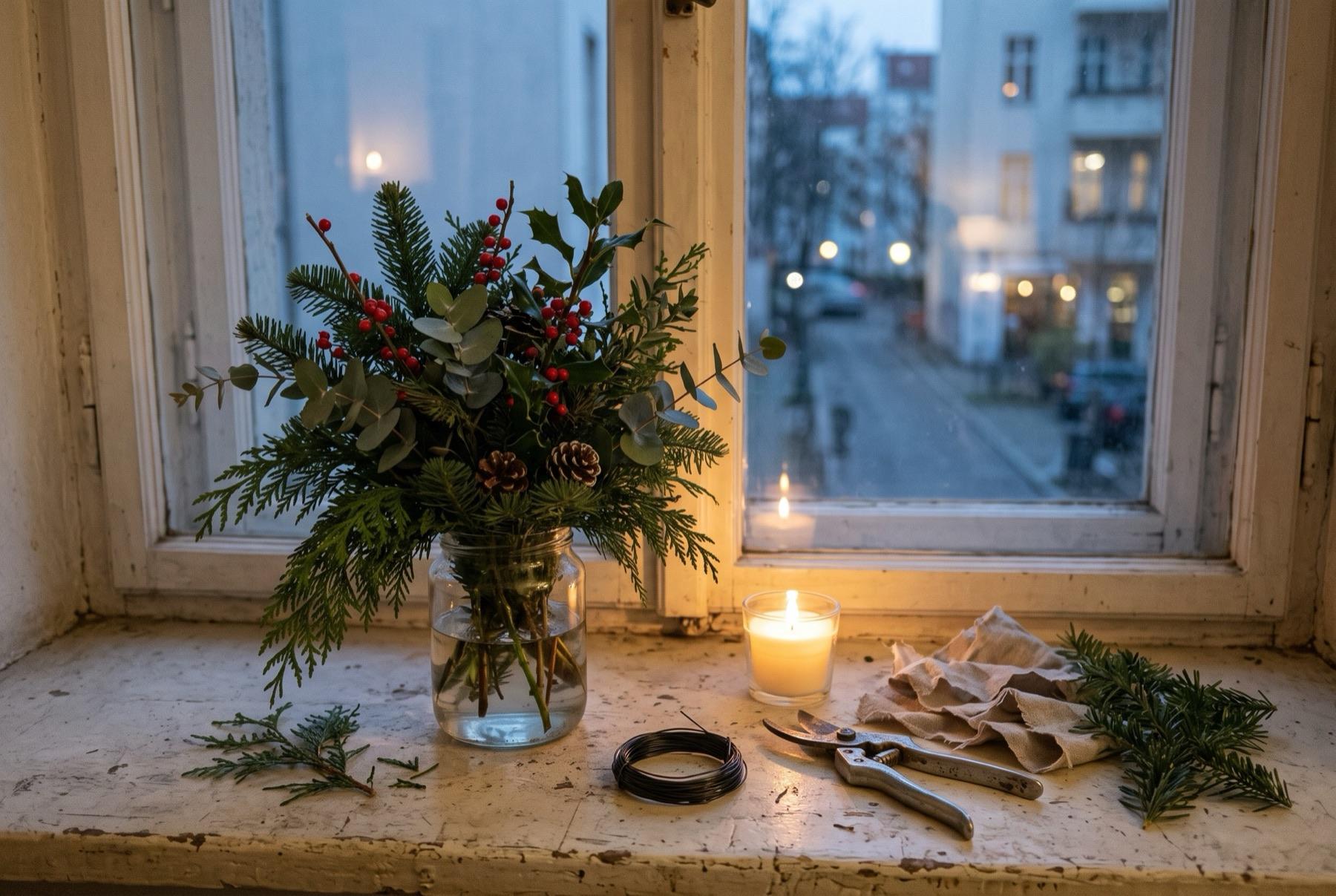
In the end there are four decisions, and none of them is purely a matter of taste. The base determines how long the piece will carry. The shape follows the eye level of the people in front of it. The greenery gives the character, the light gives the mood. Once you have answered those four questions, you recognise at a glance whether a Christmas centerpiece was built for your table.
And then a Christmas centerpiece is allowed to be simply beautiful. A cedar branch falling over the edge, an amaryllis holding the eye, a cone throwing shadows in candlelight. That is the part that still gives us the most joy after over 25 years.
Would you like Christmas floristry that suits your rooms rather than a catalogue? Tell us about your building, your tables and your December. You can see how we accompany companies through the season on Business. Send us the form on Contact, and we will get back to you personally. When we bind and when your arrangement is in place is something we settle in the first conversation.
Christmas Table CenterpieceChristmas CenterpieceChristmas Floral ArrangementAdvent CenterpieceAdvent WreathChristmas Table ArrangementModern Christmas Centerpiece


