The flower arranging workshop in Berlin at a glance:
- Three formats Berlin binds: bouquet, arrangement and dried flowers
- For teams from 20 people: departments, companies and groups at one long table
- Built for beginners: nobody on the team needs experience, only curiosity and two hands
- A creative session, not training: we are a floral design studio, not a training provider
- Guided, not performed: Elis and the team move from seat to seat until the movement sits
- Nothing fixed: format, frame, group and date are agreed with you personally
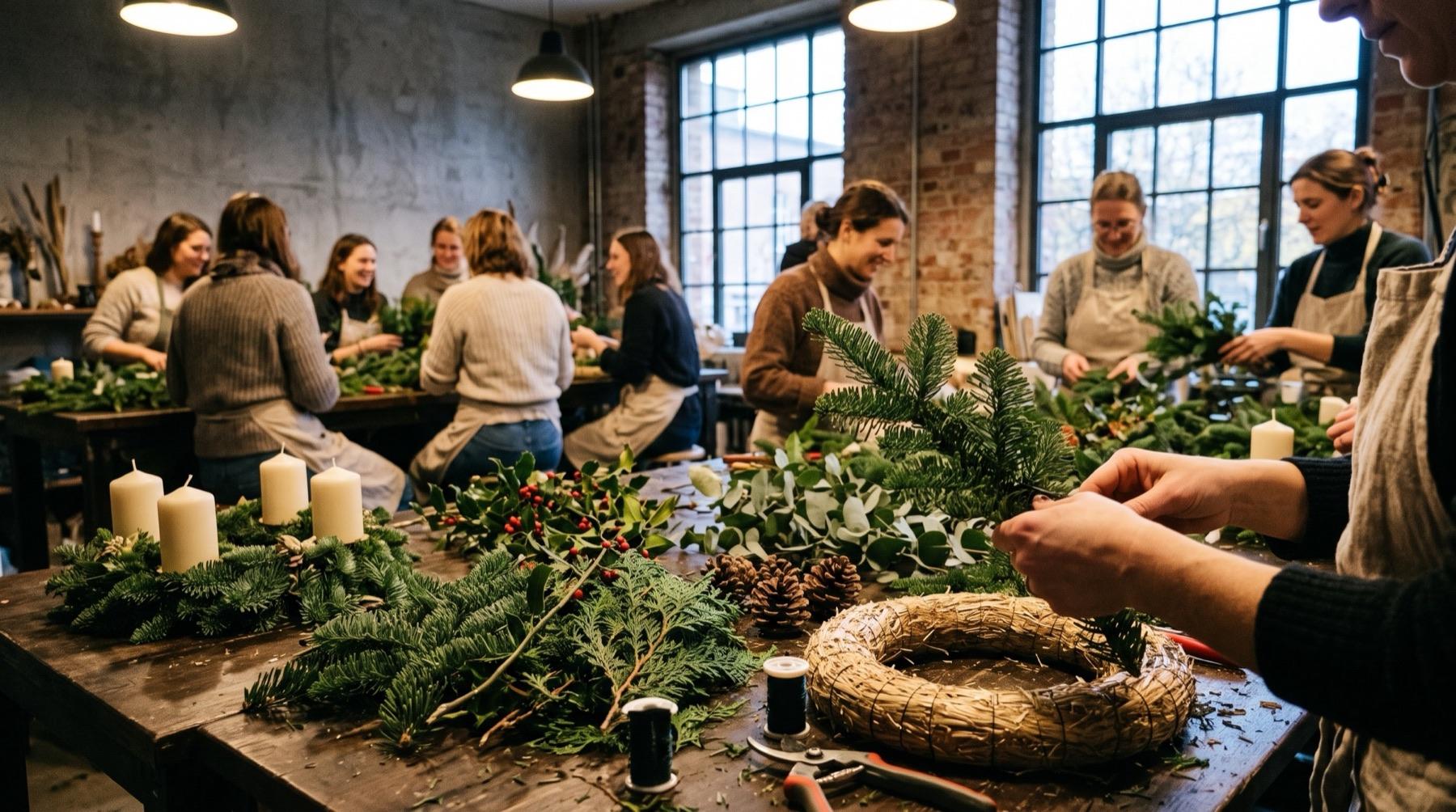
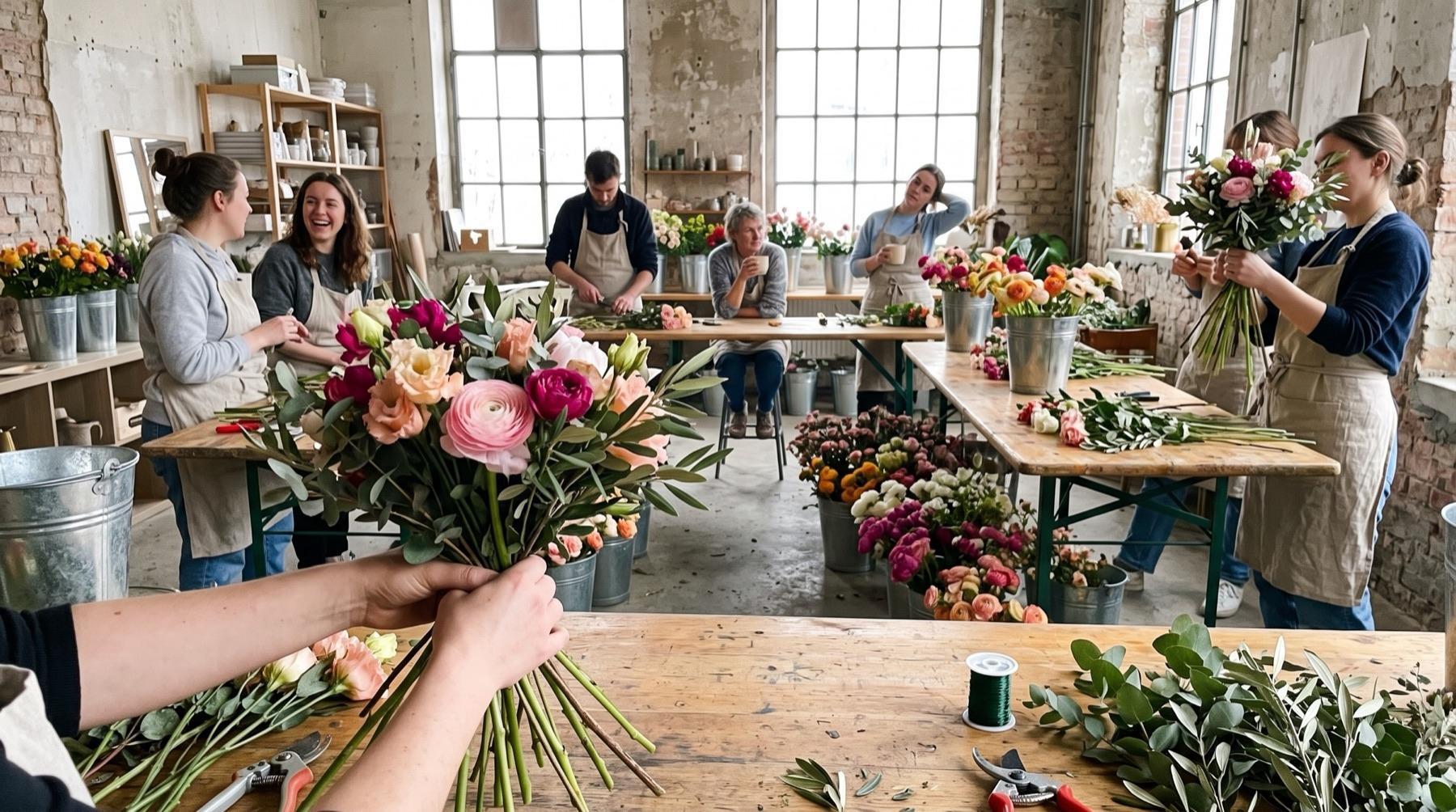
It smells of eucalyptus long before the first stem lies in anyone's hand. On the tables stand secateurs, zinc buckets and shallow bowls of floral foam that soaks itself full of water with a quiet hiss. The water in the buckets is cool, and a film of green and resin stays on your fingers. At the far end of the table somebody cuts a rose, and that short dry crack carries across the whole room. Then the first person picks up a stem, lays the second against it at an angle, and by the tenth has stopped counting. Hands understand faster than heads in moments like that.
That is exactly what our workshops are for. We have been creating floristry for weddings, events and brands for over 25 years, in Berlin and on Mallorca, and in that time we have learned one thing. Craft cannot be explained, it has to have been in your fingers. A flower arranging workshop in Berlin is the shortest route there, because at the end something stands in front of every seat that was only a bundle of stems before.
We will show you which formats there are, how it goes at the work table, what your team can really do afterwards and why we talk about seasons before we talk about flowers. Let yourself be inspired.
Which flower arranging workshops are there in Berlin?
In Berlin there are above all three things to bind: the bouquet, the arrangement and dried flowers. All three work at a long table seating a whole department. Which one suits you is decided less often by taste than by the season and the occasion.
Three formats, three handwritings
The bouquet – the format for a first attempt. It holds the spiral technique, where every stem lies at an angle in the same direction and the bouquet becomes round by itself. You work with whatever is in bloom, and after a few movements everyone notices that one flower too many can tip the whole structure. Anyone who has understood how a bouquet carries itself binds every further one more freely.
The arrangement – floral foam, greenery and a sightline. An arrangement grows in soaked floral foam sitting in a shallow bowl or on a plate. The greenery goes in first, set flat and outward so it covers the rim of the bowl and forms the framework. Then come the flowers, the lowest first, and only at the end the tips. Because an arrangement is seen from every side, you work towards a sightline rather than a front, and that is exactly what makes it the format for the dining table and the reception.
Dried flowers – the format with no clock ticking. Dried grasses, strawflowers and honesty need no water and forgive a pause in the middle of binding. In return they ask for a calmer hand, because dry stems break sooner than they bend. Anyone who fears wilting is in good hands here.
Which format suits what
| Format | The technique behind it | What it suits in a team |
|---|---|---|
| Binding a bouquet | spiral technique, all stems at an angle in the same direction | pieces everyone takes home individually, all year round |
| Setting an arrangement | soaked floral foam in a bowl or on a plate, greenery first | the dining table and the reception, when a room is to be dressed |
| Dried flowers | setting and wiring without water | dates with no regard for flowering season or shelf life |
| Format for large groups | agreed in advance, depending on group and occasion | departments and company celebrations from 20 people |
The right-hand column sorts the formats by occasion, not by our calendar. Dried flowers follow the property of the material, not the season.
In autumn the material becomes heavier and more colourful, and many teams put their date exactly there. As soon as the days get shorter, rosehips, the last dahlias and branches lie on the table, and an arrangement from that material carries a reception without any further decoration. In spring the picture turns, and then the seasonal bouquet is what is asked for.
Anyone wanting to bind with their team during advent will find a format of its own for that, the advent wreath workshop in Berlin. Which format suits your preferred date and the frame we set it in is something we discuss personally. Write and tell us briefly what you have in mind and we will come back with everything else.
The season usually picks the format itself, you only have to reach for it.
Who we lay the tables for
When nobody on the team has ever bound anything
The question that reaches us most often is not what a flower arranging workshop costs, but whether you have to be able to do something for it. The honest answer is no. Almost everyone who sits down at our table has never bound a bouquet before, and the first grip feels equally awkward for all of them.
We show every movement on its own, from the first cut to the last knot in the wire, and as often as a group wants to see it. Nobody needs to bring more than curiosity, two hands and a willingness to pull a stem back out again.
Teams, companies and the occasion behind it
We lay the tables for teams, companies and groups from 20 people. That is not an arbitrary limit but the group size at which a long table, the material setup and the seat-by-seat guidance come together sensibly. Departments come, whole sites, project teams who have only seen each other in video tiles since the last rollout.
The occasion helps decide which format goes on the table. A January kickoff takes bright material and a bouquet everyone takes home. A year-end review tends towards the heavier and more colourful. At a client event the arrangement counts, because it stays standing on the table and at the reception, and during onboarding the binding is above all an occasion to talk to each other. It is the same flowers for everyone, and at the end the proof stands on the table that floristry has more to do with attitude than with rules.
A creative session, not vocational training
Anyone looking for a floristry course as a way into the profession has come to the wrong address, and we would rather say that beforehand than afterwards. We are a floral design studio, not a training provider. There is no exam here, no curriculum and no certificate that anyone will later recognise.
What there is, is the craft from the workshop, exactly as we apply it daily, only explained more slowly. For a career change or a professional seminar you need a floristry school. For the afternoon on which a team builds something beautiful with their own hands, you need us.
Prior experience is not a requirement here, at most a shortcut.
You have an occasion and no format yet? Then tell us about your preferred date. A few sentences are enough to start with, everything else we discuss personally. Free and without obligation.
How a flower arranging workshop runs with us
Every flower arranging workshop with us follows the same rhythm, whether bouquet, arrangement or dried flowers. What changes is the material on the table, and that follows the season. The sequence itself has barely changed over the years, because in this order it carries a large group calmly too.
Arriving and reading the material
Before anyone picks up a pair of secateurs, we go over the table together once. Which flower carries the bouquet, which greenery fills, which branch sets the direction. That sounds like theory but it is the part that saves the most time later.
Because the most common uncertainty at the start is not the technique but the choice. Anyone who knows which three flowers set the tone and which only accompany reaches for them with more confidence.
The movement everything builds on
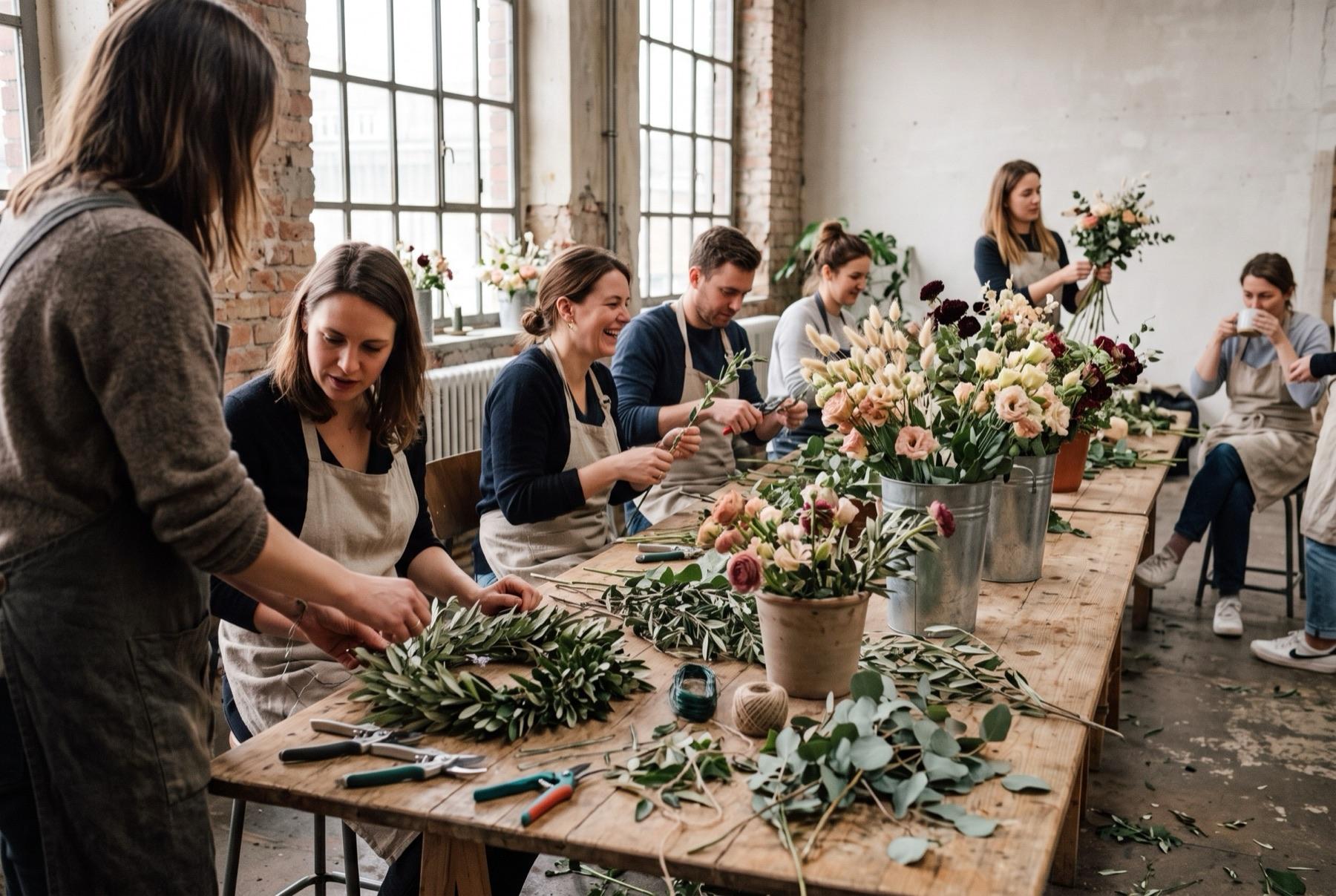
Then Elis demonstrates the technique once, slowly and from the front. In the spiral technique every stem lies at an angle in the same direction, always at the same point above the thumb, and the bouquet opens by itself. For the arrangement you first set the greenery flat into the soaked floral foam until the rim of the bowl disappears, and only then place the flowers.
Insider tip: Turn the bouquet, not your hand. Anyone turning their hand with it loses the binding point and wonders why the bouquet tips. The hand stays still, the stems come to it, and the binding point stays the same throughout. That one sentence saves several bouquets in every workshop.
Binding with guidance
After that the group works. Elis and the team move from seat to seat, correct an angle, tell everyone when an arrangement is dense enough and when it is only getting heavy. Colour, fullness and form are decided by each person alone, even when we would have done it differently.
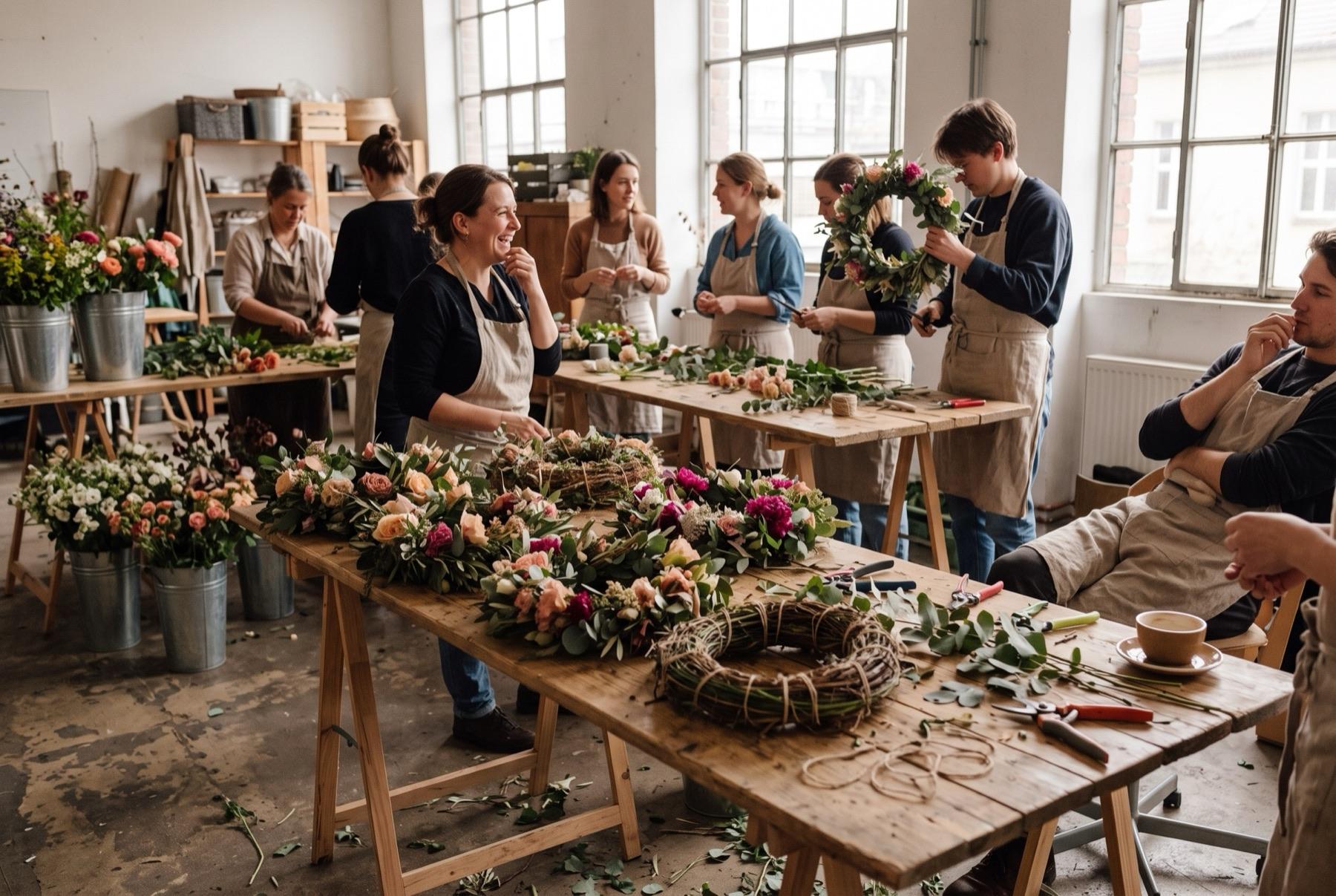
At the end we place all the pieces side by side. That is the moment when most people notice how differently the same flowers turn out in different hands, and usually also the moment the phones come out.
A good workshop does not explain to a group how it works, it lets them notice that they can do it.
What your team takes from the table
The piece
At the end something stands in front of every seat that did not exist before, and it is not a copy of ours. You can see who set an arrangement, in its density, in its sightline, at the point where somebody got bold. What happens to the pieces at the end is something we discuss with you in advance.
For longevity there are two simple rules. Fresh greenery stays beautiful longer when it stands cool and out of direct sun, and dried material wants a dry and shaded spot, otherwise it bleaches out over a summer.
Four movements that stay
The piece fades eventually, the technique does not. After a flower arranging workshop your team can lay a bouquet in the spiral technique, build up a bowl of floral foam evenly, place binding wire so that it holds and still disappears, and cut stems so they draw water instead of blocking.
That sounds like little and changes a surprising amount. The supermarket bouquet that would otherwise land in the nearest vase is suddenly taken apart, layered anew and cut. That is exactly how we recognise people who once sat at our table.
What remains is less a piece than a habit.
What do flower arranging workshops in Berlin cost?
What a flower arranging workshop in Berlin costs is decided by five factors, and the price of flowers is only one of them. Depending on how lavish a piece becomes, how large the group is and where the binding happens, the same format ends up far apart. That is why we calculate every workshop individually.
Five factors that determine the effort
- Material: how many flowers lie at each seat and whether seasonal stock, dried stock or both are worked. Lavish pieces simply need more flowers.
- Scope: a bouquet is bound faster than a densely set arrangement. The effort sits in the surface that gets filled.
- Group: how many seats we lay and how many hands want guiding at the same time.
- Place: whether we receive you or whether material, tools and buckets travel to you. Transporting fresh flowers is the underrated item.
- Size of the piece: bowl diameter and bouquet volume determine the quantity of flowers more directly than anything else.
Why the amount belongs in the quote
A number on this page would be convenient and mostly wrong. We name the amount as soon as we know what your team wants to bind and in what frame, and then it stands in writing before you commit. That is less convenient than a price tag and more honest in the end.
Anyone wanting to understand why fresh floristry costs what it costs will find the long answer in our piece on why fresh floristry holds its value. Much of it applies at the work table just as it does at a wedding table.
It is not the price that separates two workshops, but what lies on the table.
A flower arranging workshop as a team event in Berlin
When a whole team binds, nothing changes about the craft and everything about the dynamic. Nobody competes, nobody has to win, everyone works with their hands, and at the end a piece of their own stands in front of every seat. That carries mixed groups better than most formats calling themselves a team event.
This page explains the craft, so the formats, the technique and the material. The room, the occasion and the path from enquiry to the table we clarify in conversation. If the celebration itself is to be dressed with flowers rather than just bound at, that is a different task, and we talk about it under event floristry in Berlin.
Which flowers lie on the table and when
The difference between two flower arranging workshops in the same year is not in the sequence but in the buckets standing beside it. We work with nurseries and wholesalers we have dealt with for years, and we take what is good at the time. That makes every date a little different.
Spring, when everything arrives at once
From March the work table becomes crowded, in the best sense. Ranunculus brings its wafer-thin layers, tulips keep growing after binding and shift a bouquet overnight, and from May the powdery scent of peony lies over everything. For beginners this is the most forgiving time.
Anyone wanting to know what actually blooms in which month will find it sorted in our overview of which flowers are in season when. The same logic applies at the work table as at a wedding table.
Autumn, when the material gains structure
From September the material becomes heavier and more colourful. Rosehips, eucalyptus, the last dahlias, ivy trails, plus branches that were still on a tree the day before yesterday. Autumn arrangements live on structure rather than on blooms, which is why almost everyone gets them right first time.
During advent it then gets tighter and more fragrant, conifer greenery sets the table. If instead a company wants to carry its rooms through December, that is no longer a workshop question but one of Christmas decoration for companies.
Dried flowers and the quiet months
Between the waves stand the dried flowers, and they are more than a stopgap for February. Grasses, honesty and strawflowers have a colouring of their own, matt and dusty, that fresh stock never reaches. They hold still until you have made up your mind.
“When a team binds for the first time, I deliberately put no peony on the table. A full bloom forgives no second attempt, and a second attempt is exactly what you need at the beginning. I would rather give sturdy stems and plenty of greenery, then somebody dares to pull a stem back out. Courage matters more at the work table than expensive material.”
At the work table the season is not a topic, it is the material.
Frequently asked questions about flower arranging workshops in Berlin
These are the questions that reach us most often.
Is a flower arranging workshop in Berlin suitable for beginners?
Yes, explicitly. Most people who sit down at our table are binding for the first time. We demonstrate each technique on its own, the spiral binding, setting into soaked floral foam, cutting stems, and we stay with every seat until the movement sits. Nobody needs to bring more than curiosity and two hands.
How long does a flower arranging workshop take?
That depends on the format, and we set the frame with you beforehand. A bouquet is bound faster than a densely set arrangement, and the pace at the long table follows the group. Tell us what you have in mind.
What does my team need to bring?
Very little, and we clarify exactly what with you in advance. Everyone wears clothes that can take greenery, water and a drop of plant sap, and ties long hair back. Anyone with a favourite pair of secateurs brings them, because they sit better in the hand than any borrowed pair.
Do we take the pieces with us?
What happens to the pieces at the end is something we discuss with you beforehand. For longevity the same rule applies either way. Fresh greenery likes it cool and out of direct sun, dried flowers want a dry and shaded spot. We show both at the table before anything is packed up.
What is the minimum group size for a flower arranging workshop?
We work with teams, companies and groups from 20 people. How much larger the group grows depends on the room and the format, and we agree that with you. We plan larger groups so that Elis and the team can still stay with every seat.
Can I book a flower arranging workshop as a team event?
Yes, that is exactly what the format is built for. The room, the occasion and the path from enquiry to the table belong in a conversation, not in a form field. Tell us about your team and we will suggest a format that suits the group.
Are there fixed dates or do I book on request?
We agree dates with you personally. If you have a date in mind, ask early, particularly at the start of autumn and for December, because many companies plan in those same weeks. A large group needs more room in the calendar than a date in spring.
Does the flower arranging workshop replace training or a career change into floristry?
No. Our workshop is a creative session for teams and companies, not vocational training. Anyone looking for a floristry qualification, a career change, a professional seminar or a certificate needs a floristry school. At your table there is binding, with no exam, no curriculum, and a finished piece as the result.
Your hands, your piece
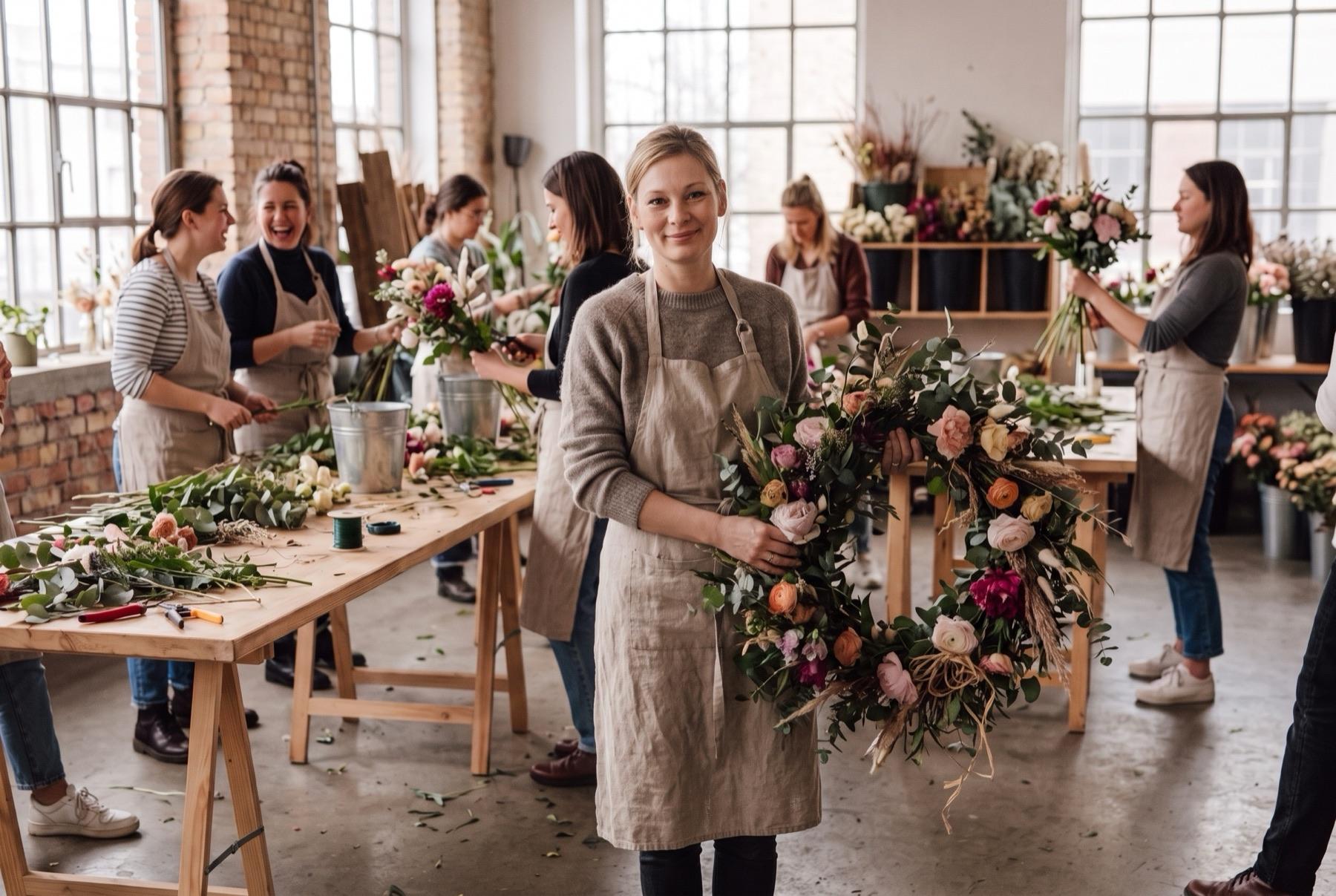
At the end of a flower arranging workshop the table looks like it does after a good meal. Cut stem ends, wire and a few leaves lie everywhere, and beside them stands a row of pieces that were only sitting in buckets before. That transition is the reason we pass the craft on.
You need to bring nothing but an occasion and some idea of what you like. Everything else, from the format to the frame, we develop with you in conversation. And if it is not yet settled whether it will be a bouquet or an arrangement, that is the most normal starting point there is.
Questions? We are happy to advise you, free and without obligation. Tell us what your team would like to bind
Flower Arranging Workshop BerlinFlower Arranging ClassFloristry WorkshopCorporate Flower WorkshopBouquet Making WorkshopDried Flower WorkshopTeam Building Berlin